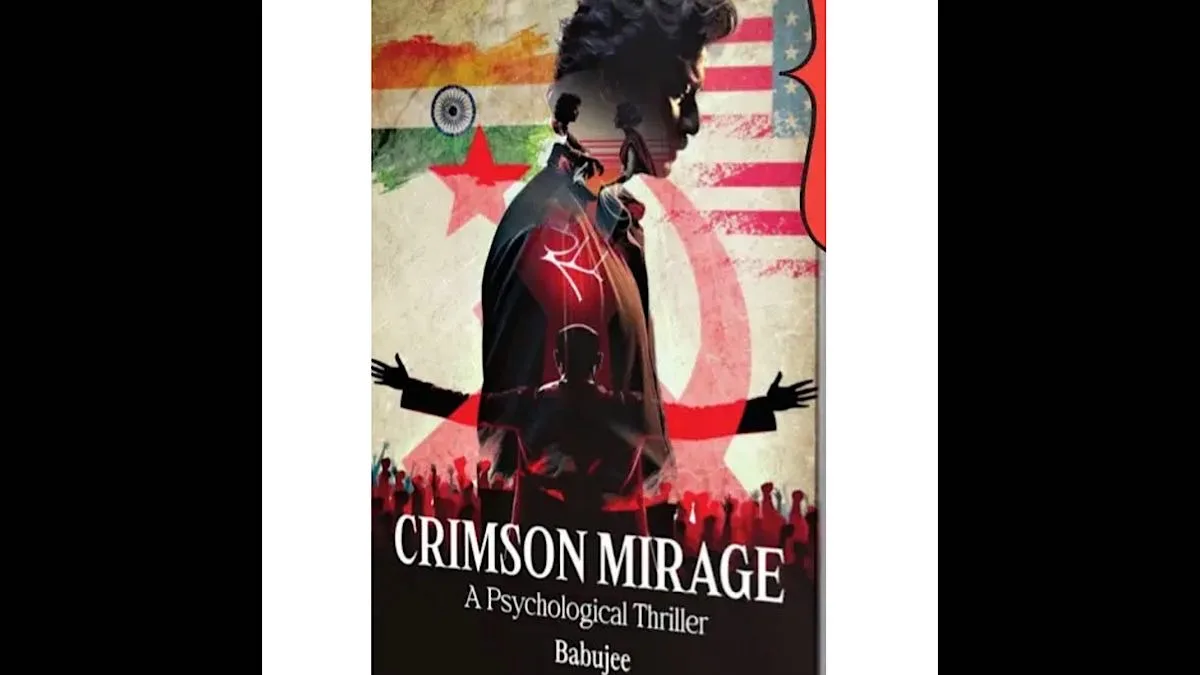
The debut novel of Babujee, “Crimson Mirage” is an insider’s account of the Naxal uprising of the late 1960s and early 1970s. Though fictionalised and protective of the identities of the lives reflected in his story and the deep throats who spoke to him and divulged the literally gory details of what went on behind the scenes, this is the chilling tale of how a mission, which set out with noble intentions ripped itself apart as it turned into a monstrous mockery of its own ideals and was eventually brutally crushed.
The narrative that unfolds is familiar to those aware of the history of the Naxal movement, which saw hundreds of bright young students, academics and intellectuals of Calcutta jump into the fire of a revolution, drawn ostensibly by the promise and ideals of a just world but really – usually, or at least often – dragged into it inadvertently by circumstances. In many cases it was a combination of youthful idealism and infatuation.
Advertisement
Manush, the protagonist, is a student of “Residency College” (guessing the educational institute it alludes to is a no-brainer), who is attracted to Mita, another college student. Middleclass, with no other intention of enrolling in a college for brilliant students than the ambitions of the common man (get ahead in life, professionally and personally), Manush is introduced to revolutionary politics through Mita, who comes from a rich and influential family of Calcutta.
“Manush was the district topper in his school-leaving examinations. Coming from a nondescript small town far away from Calcutta, he did not have the slightest comprehension of the complex urban brew….his boyhood dreams were larger than life, so sweet, so naïve. Ever since he could remember he had wanted to be the best, reach the very top….now he was away, from his nondescript, but idyllic, life at his parents’ home. He was taking the first steps to fulfil his dreams….Around this time, he fell victim to the chronic ailment that afflicts every Bengali boy who turns 18 – writing poetry, seeped in the unspeakable agonies of a lovesick, nostalgic, despondent soul.” Mita, on the other hand, was a representative of Calcutta’s upper crust. “Ironically, most of the wide-eyed fans and supporters of the ultra-Left leaders were children of the rich and the famous. Their hearts bled for the hungry, the deprived and the exploited. They spent their days with the firebrand messiahs in college. They basked in the halo of borrowed intellectual capital. They shared the thrill of their defiance of authority. They wallowed in the unshakable confidence in Bengal’s spirited and revolutionary past, believing that they could usher in a new Red dawn over Bengal’s horizon….Then at the end of each day, expensive cars, driven by liveried chauffeurs would take them back to their mansions in the upscale South Calcutta localities of Alipore or Sunny Park, or even the heritage, one-time aristocratic, manors of North Calcutta districts.” (Mita lives in Sunny Park). Babujee writes, “Manush read his own poems with a wistful air, over and over again, by the open window of his hostel room, fantasizing that his voice was floating over the cacophony of night-time Calcutta and gently seeping into Mita’s room at Sunny Park.”
Such ironies underlined the way that the Naxal movement unfolded and Babujee brings them out skilfully, sometimes pointing them out directly through the omniscient voice, without didactic, judgemental undertones, and sometimes merely through the unfolding plot, depicting helpless, hapless characters who get caught in the crossfire of the conflict and confusion between who exactly is the “class enemy” that the Naxals are hellbent on exterminating and who is not.
Two of the most poignant depictions of these ironies are the spine-chilling and heart-wrenching episodes that the author weaves into the plot….one is the stabbing and beheading of a cop, a traffic constable “eliminated” simply for being a “policeman”, a category that figures high on the Naxals’ list of “class enemies” and therefore hitlists and the other is the rebels’ shoving rice mixed with the blood of her just-butchered sons into the toothless mouth of an old, widowed woman.
Though fictionalized as the Janabari killings in the novel, the latter is actually based on a real incident, known as the Sainbari murders, in which ultra-Left rebels barged into the house of a zamindari family in Bengal’s Bardhaman district at night just as they had sat down to have dinner, and killed two of its male members, alleged to be extremely cruel and exploitative and later stuffed their mother’s mouth with rice mixed in their blood for crying for them to stop. As for the former episode delineated in the narrative, it was a common occurrence. In the novel, the Naxals, led by Manush, who by now had become one of the movement’s most feared faces with a price on his head, did not do any background check before butchering the traffic constable – he was a man from a poverty-stricken family who somehow landed the job after the death of his father and was the sole breadwinner of an impoverished household, where his widowed mother looked forward to his homecoming every evening.
Babujee’s deeply sensitive narrative, studded with characters who come alive with the subtle complexities of human nature (often revealed just before they are killed or drop dead) makes this book one of the most balanced, not to mention vivid accounts of those disturbing times. The brutal crushing of the rebellion is depicted with equal, if unstated empathy. The notorious stories of the kinds of torture that was meted out to the rebels, is dealt with, with as much incredulous horror (which is always tacitly conveyed rather than overtly stated) as his depictions of the rebels’ coldblooded killings – which followed the diktats of the “khatam line” or the “finish-off” policy.
Consider this blood-numbing, soul-crushing account:
Vanu Das, the cruel police officer described by Naxals as “Yamdut” the Death God, tells Manush about the fate that has befallen his captured comrades, who have somehow survived the police’s torture chambers. “Once someone goes into those rooms, they cease to exist. They may seem physically normal – a body with motion – but we squeeze every ounce of juice out of it. They come out as empty, spent shells – beating hearts, warm blood, but without a soul.” The diabolic, sadistic utterances notwithstanding, the character is shown also to have moments of compassion. One of the best and most entertaining and engaging characters in Babujee’s book is another police officer, Bosebabu, the lazy officer-in-charge of a Bengal village, who is suddenly jolted out of his comfortable life with the discovery that the area under his jurisdiction is Naxal-affected.
This is the best part of Babujee’s book. The ability to convey the complexities of human nature, of human predicament which could have blurred and become a black and white narrative about good and evil during one of the most disturbing episodes in the history of Bengal with nuance.
In the end, the writer is able also to convey powerfully the utter disillusionment of those who joined the movement, knowingly or unknowingly. The realizations that the very people who they are supposedly fighting for, may or may not identify with the imported theories of a foreign land, especially the violent means which they were egged on to participate in. The sudden discovery that the real passion, dream of even the most vociferous leaders among them was to lead normal lives. Not the bloodstained lives they found themselves in with blood on their own hands. This book is about that “crimson mirage.”
Babujee, which is penname, lived through those turbulent times in Bengal and this book, as I said earlier, is an insider’s account, an excellent one at that. It is self-published by him and is available on Babujee.substack.com.
The reviewer is Editor, Features, The Statesman.